Application / 08 · Heat transfer
Check heat conduction in a cooling block against the exact solution.
Does the heat solver reproduce three-dimensional transient conduction through a body that loses heat at its surface?
Availability: In development
- Inputs
- A 0.1 m steel cube (7850 kg/m³, 470 J/(kg·K), 45 W/(m·K)) that starts uniformly at 600 K. Every face loses heat to 300 K surroundings through a film coefficient of 900 W/(m²·K), a Biot number of 1 on the half-width.
- Variables to explore
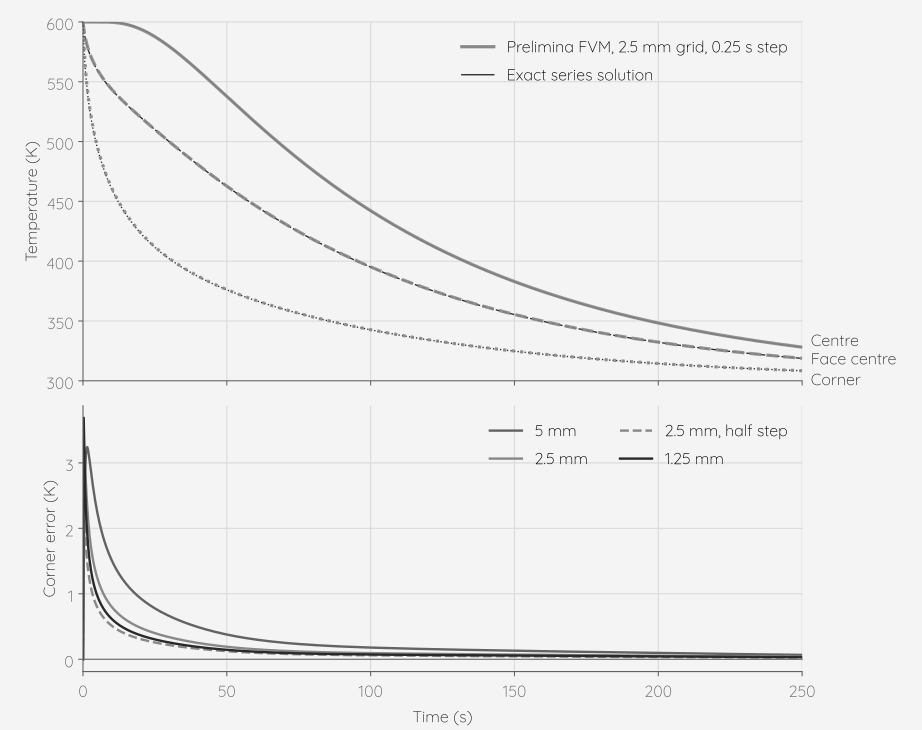
- Grid spacing (5, 2.5 and 1.25 mm) and the time step (0.25 and 0.125 s).
- Keep the comparison consistent
- The geometry, properties, initial temperature and surface condition of the exact solution. Each probe averages a few cells at the centre, a face centre and a corner, and the exact solution is averaged over the same cells.
- Outputs
- Temperature histories at the three probes and the heat flow through each face, exported as CSV, and the temperature field.
- Comparison with the exact solution
- After the first 10 s, the 2.5 mm run stays within 0.32 K of the exact solution at the centre, 0.28 K at the face centre and 0.80 K at the corner, against a 300 K drop. In the first second, as the hot block first meets the cool surroundings, the corner error peaks at 3.1 K; halving the time step lowers it to 2.1 K. Heat lost over 250 s: 1035.8 kJ against an exact 1036.1 kJ (−0.03 %); all four runs are within 0.05 %.
- Physical assumptions
- Pure conduction. Prelimina has no separate solid model, so the liquid model fills the cube and is held still: there is no gravity and no buoyancy, the velocity stays exactly zero, and the energy equation reduces to conduction with steel’s properties. The properties are constant. The surroundings enter only through the film coefficient.
- Scope
- A comparison with an exact solution, not with an experiment, and for the FVM solver only; the FLIP and FIRM heat solvers are not shown. With the time step held at 0.25 s, refining the grid from 2.5 to 1.25 mm changes the later errors little, because the time step then sets most of the error. Heat transfer is experimental and covers the liquid only: there is no gas side, ullage or phase change yet.