Application / 09 · Heat transfer
Check buoyant air flow in a heated box against a benchmark.
Does the solver reproduce buoyancy-driven flow, and the heat it carries across a closed box, from slow creeping flow to thin wall boundary layers?
Availability: In development
- Inputs
- Closed square boxes of air (Prandtl number 0.71) with one side wall at 305 K, the opposite one at 295 K and insulated top and bottom, under normal gravity with Boussinesq buoyancy. Box sizes of 10, 22, 47 and 102 mm give Rayleigh numbers of 10³, 10⁴, 10⁵ and 10⁶.
- Variables to explore
- Rayleigh number, through the box size, and grid spacing (32, 64 and 128 cells across).
- Keep the comparison consistent
- The geometry and wall conditions of the de Vahl Davis benchmark: a two-dimensional square cavity, modelled one cell deep between symmetry planes. Each run continues until the heat flowing in at the hot wall equals the heat flowing out at the cold wall.
- Outputs
- The heat flow through every wall over time, exported as CSV, and the temperature and velocity fields.
- Comparison with the benchmark
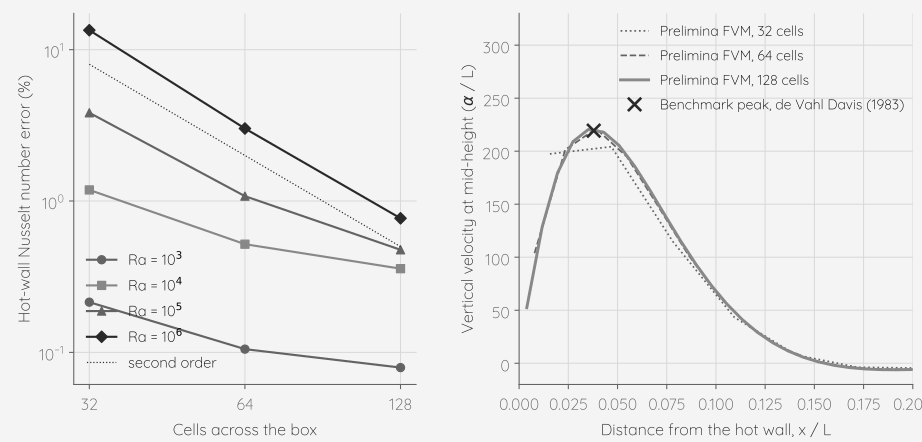
- On the 128-cell grid the hot-wall Nusselt number is within 0.8 % of the benchmark at every Rayleigh number (+0.1 %, +0.4 %, +0.5 % and +0.8 % for 10³ to 10⁶), and the peak horizontal and vertical velocities on the mid-planes are within 1 %, at the benchmark positions. At Rayleigh number 10⁶ the Nusselt error falls from 13.4 % on 32 cells to 3.0 % on 64 and 0.8 % on 128, about four times per halving of the cell size, as expected of a second-order method.
- Physical assumptions
- Boussinesq buoyancy with constant air properties, in two dimensions. The box is completely full, so the volume fraction of the liquid model is held at one; left free, it does not conserve the volume of a completely full box. The pressure-solver tolerance is relaxed to 10⁻⁶ (10⁻⁵ for the 128-cell run at 10⁶), a level that single precision can reach in these small cells.
- Scope
- A comparison with a numerical benchmark, not with an experiment, and in two dimensions; the benchmark states an accuracy of about 1 % at Rayleigh number 10⁶. The results are for the FVM solver. The FLIP solver’s walls are free-slip, so it does not form the wall boundary layers: on 64 cells its heat flow is within 5 % of the benchmark up to 10⁵ but about 50 % high at 10⁶, and its peak velocities sit at the walls. Heat transfer is experimental and covers the liquid only.